inverter or generator
-
photo finish
- Commodore

- Posts: 1551
- Joined: Mon Sep 27, 2004 3:55 pm
- Contact:
Before I replaced my old genset I did think about a large inverter. At the time I was tired of always fixing the rust bucket and thought why not get rid of one of the engines on the boat but living in Fl and always run the a/c it did not seem practical. John I would love to know the particulars of your system How many batteries etc.
Tim Stamm Photo Finish 1981 33' Bertram FBC 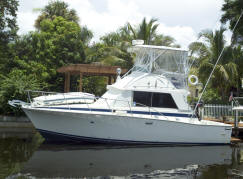

Tim, My inverter bank is made up of (4) 6 volt golf cart batteries. These are about the cheapest option for extemely well built deep cycle batteries that are capable of repeated discharge/recharge cycles. This bank gives me about 450 amp hours of power but I only discharge them to 50% (225 amp hours) becuase this greatly increases battery life. My inverter is made by Heart and it's both an inverter and 3 stage charger with some nice battery maintenace features. I also sprung for the shunt and remote diplay which monitors useage, charge/discharge, percent remaining, charge efficiency, voltage, amp draw and return...etc. I can overnight with the fridge on, use the tv, dvd player, radio and some 110 lighting and only use about 20-30% of the batteries capacity. If I was running a small AC, this bank would be insufficient. In fact, a doubt a bank twice as large would be enough to obey the 50% rule for anything more than 1 night. My system has served me well for how we use our boat but with AC, I think a gennie is a better option. Lastly- I did lose my inverter once during a lightning storm. Heart honored the repair but it would have cost me almost the cost of a new unit to repair it. I'm told inverters are very sensitive to spikes but in the 6-7 years I've had mine, I've replaced the battery bank once and only had the one repair which cost me nothing.
John V

The start up current for the A/C is the range of 15 Amps, or about 1.5KW. 10 Amps is nominal once you've got it up and going. That seems like a lot to ask from an inverter and battery bank. Inverters are great little tools for something like a small microwave, fridge or coffee pot. But unfortunately if you want the high current for extended periods, the generator is still the best answer. Rick Ticket 85 SF Merc 454 MPI's Falmouth, MA
Rick
Ticket 85 SF Merc 454 MPI's USCG 50T Masters w/ Towing Endorsement
Falmouth, MA
Ticket 85 SF Merc 454 MPI's USCG 50T Masters w/ Towing Endorsement
Falmouth, MA
Anything is doable, and lots of folks get away with doing things that aren't "technically correct" and it works for them. I try to do things the right way to avoid problems later and even that doesn't always work out. Rick- I'm not sure the current you speak of is for a 16k BTU ac unit... it seems to me that those numbers are closer to a 6k-8 KBTU unti... I'd have to check. Going from memory and doing some quick math- a 16K BTU air cond. (110VAC) may draw close to 20 amps while running- with a surge current on start-up approaching 30-35 amps. Those are AC amps- converting that to DC amps using an 80% efficient inverter system means you'd need around 250 amps continuous at 12 VDC- perhaps more than 400 amps surge! The batteries could probably handle the surge demand as long as the inverter could. BUT- All in all- that's a pretty beefy system. Not many alternators will reliably put out 250 amps continous and the wiring for those loads would have to be carefully planned and implemented. Also- in as much as you say you'd only want it for the Air Cond. underway... would you be running it as a dedicated system?? IE- seperate wiring from the rest of the "boats" AC power demands? In my case- all my AC loads are serviced by either a shore power hook-up or they are auto transferred to the inverter when shore power is lost. That means my fridge will automatically start to draw off the inverter as will my water heater, my stove (if I chose to us it)... basically any AC load on the boat will work seemlessly... even during a power outage at the docks. Unless your going to seperate the Air Conditioner and inverter system completly from the rest of boats AC loads, you'd have to go around and shut down other loads on the AC side if they would exceed the inverters ratings. It seems to me there are better ways of achieving your goal if all you desire is Air Conditioning while underway but, if done correctly- it can work.
John V
-
photo finish
- Commodore
- Posts: 1551
- Joined: Mon Sep 27, 2004 3:55 pm
- Contact:


Thanks Doug. I thought so. Diesels make almost NO CO. A small diesel genny would have to have serious issues to make CO. Most genny diesels are naturals that have no air filters, just screens. The chance of making CO and then that CO getting into a confined area is just about zero. Placing a genny in the engine room of our Bertrams can present some issues. One would be an exhaust leak. I would fear fire before CO killing me. Also the boat filling up with water could be an issue. There is nothing wrong with installing a CO detector. It would be third on my list. First fire, second high water alarms and a very distant third would be CO. You gasser guy should add a CO detector without a doubt.
Charlie 35 Bertram 3208 Cats
-
BECCA ROSE
- Commodore
- Posts: 1301
- Joined: Thu Feb 10, 2005 12:46 pm
- Location: USA

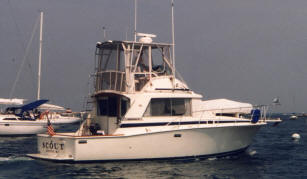
Bertram realized the mail boxes were not a good idea and discontinued them before my 1984 model year. What I dislike the most about the mailbox aside from the delamination issues are the unsightly black streaks on the sides of the hull. Just ugly. Something I found by google. Even under maximum load, a Diesel's exhaust contains less than 0.4% carbon monoxide. By contrast, all gasoline engines easily produce 7% CO--and, with some adjustment of the idle mixture adjustment screw on the carburetor, as much as 12%. Diesels, by contrast, have no carburetors to begin with; no adjustments are possible. Diesel exhaust from any idling Diesel engine is actually oxygen-rich with about 18% oxygen. This is because of the peculiar nature of Diesel combustion which relies upon excess air to achieve ignition. Soot particles not CO is what you should worry about on diesel boats. Breathing in diesel fumes can affect your health, and exposure to the fumes can cause irritation of your eyes or respiratory tract. These effects are generally short term and should disappear when you are away from the source of exposure. However, prolonged exposure to diesel fumes, in particular to any blue or black smoke, could lead to coughing, chestiness and breathlessness. In the long term, there is some evidence that repeated exposure to diesel fumes over a period of about 20 years may increase the risk of lung cancer. Exposure to petrol engine exhaust emissions does not have the same risk. If you have a diesel powered boat quit worrying about CO and worry about the soot. I like my clean burning Cats. Ever look at the same vintage DD or volvo. They have black transom syndrome.
Charlie 35 Bertram 3208 Cats