Rudder Zinc and Platforrm Zincs
-
richcatch22
- Captain

- Posts: 273
- Joined: Sat Dec 17, 2005 3:53 am
- Location: USA
Rudder Zinc and Platforrm Zincs
The rudders have no zincs. Every boat I have had has rudder zincs. Considering it an '89 and has not had them this long why add them, if it works why change? This year I had a problem with the AC power and the galvanic isolator alarm went off until I moved to another power connection. When I hauled I noticed some corrosion on the rudders as well as the platform support stanchions (no zincs and not connected to the bonding system for the platform). Anyone have any experience or guidance on this ? Thanks.
Capt Rich Catch 22 1989 33 FBC 
When I bought my boat it didn't have zincs on the rudder or the swim platform. My swim platform was bonded but not very good because there were no nuts on the bolts holding the swim platform. It had been that way for 20 years. Anyway I added zincs to the swim platform, nuts to the bolts and zincs to the rudders. Every boats I have ever owned had them on the swim platform and the rudders. Buzz
buzzk 1988 Bertram 33 FBC Cummins 6BTA's Buzz Off Morehead City, NC

Mine does not have them on the rudders or swim platform. As mine is an 86, it does not have the galvonic isolator. I put 2 on each shaft and a set on each trim tab. I have noticed the past couple of years that upon hauling the shaft zincs are gone. I can't get tme any tighter when I put them on, so they are either doing their job (albeit too soon) or they are spinning off. The issue has seemed to arise since I re-powered with diesels. Not sure if there's a connection.
Regards, Doug L.
1986 33 Bertram FBC Cummins 6BTA's Queen Elizabeth
Marblehead, MA
1986 33 Bertram FBC Cummins 6BTA's Queen Elizabeth
Marblehead, MA
Because I leave the boat in the water all year, I have a diver clean the bottom and check the zincs monthly. The swim platform zincs need changing about every two years. Of course the shaft zincs need changing more often. I would have to look up how often the shaft zincs are being changed but I think it's around every 6 months or so and then they are not all gone. The shaft zincs go faster than the trim tabs, rudder or swim platform. Buzz
buzzk 1988 Bertram 33 FBC Cummins 6BTA's Buzz Off Morehead City, NC
-
franklyprice
- Commodore

- Posts: 1661
- Joined: Tue Sep 23, 2003 1:53 am
- Location: USA
My rudders are connected to the bonding system. Because every boat I've ever owned had rudder zincs I added them on this boat. My thoughts if I ever had a problem my shaft zincs could go and some damage could occur before I knew I even had a problem.I asked my suveyor about adding zincs to the rudders and he didn't see a problem adding them. Buzz
buzzk 1988 Bertram 33 FBC Cummins 6BTA's Buzz Off Morehead City, NC

My boat only has zincs on the shafts. I had a qualified marine electrician from one of the local custom boat builders come by and check and measure the effectiveness of my bonding system. He said all checked out well. I was also concerned about not having zincs on my rudders. He explained that they were unnecessary and that “overzincingâ€� did not provide any benefit. I was under the boat yesterday and all is well. R.
"Regalo" 1983 Bertram 38 III Convertible 3208T Cats
I have shaft zincs and a divers plate on the transom. Rudders, and platform are all connected to the divers plate as is the rest of the bonding system. I do use R2s on the trim tabs, but only replace when I haul out every 18 months or so. Unfortunatly most boats in Marinas, or your neighbors do not have their boats bonded well and eat your zincs up. Gene Dugan Boca Raton, Fl. "Nauti Marie" 1989 33 FBC 2007 8.1 Crusaders
Gene Dugan Boca Raton, Fl. "Nauti Marie" 1989 33 FBC 2007 8.1 Crusaders SOLD 2000 Pursuit 2870 Offshore Twin 2016 Suzuki 200s
-
Brian Davin
- Captain
- Posts: 641
- Joined: Thu Apr 21, 2005 1:18 pm
- Location: USA
I have zincs on shafts, rudders, trim tabs and swim platform stanchions. I added zince to stanchions and then connected their bolts to the bonding system when I replaced them when I originally purchased the boat as the stanchions had corrosion holes in them. Also, if you paint rudders, stanchions, or trim tabs, use Trilux 33, as normal bottom paint will cause corrosion interaction with metal. I had called Interlux about this and they gave me this recommendation.
Brian '90 Bertram 33' FBC Yanmar 370's "Never Say Never" '70 Bertram 24' Moppie Guilford, CT (Homeport) Kinnelon, NJ (Home)
-
dstallworth
- Ensign

- Posts: 5
- Joined: Tue Sep 15, 2009 9:20 am
- Location: USA

I agree...the more the better. You never know about the boat next to you. I reworked my bonding system a year ago with #8 wire to all the metal components connected. I have a divers dream on the transom, zincs on the shafts, trim tabs and rudders. each stantion on my swim platform is connected together and then to the transom plate. My boat has been in the water since November and I had it short hauled today to check my through hull fittings after a lightning strike. All the zincs looked pretty good, but the shaft zincs will need replacement in a month or so( which is a 6 month cycle) the others should be good for another six months(which would be an 18 month life cycle). I'm pretty happy with that. My last boat had the same zinc setup, but I was only gettin about half the lfe out of them. I had the boat in a different slip and have been told that side of the marina was a little hotter(electricity).
Mike Hedberg 1977 B33 FBC Sweet Melissa Naples, Florida
What year did Bertram start delivering the boats with galvonic isolators ? I'm just curious because there had to be a reason. I've added rudder zincs and use 2 on the shafts. Rick Ticket 85 SF Merc 454 MPI's Falmouth, MA
Rick
Ticket 85 SF Merc 454 MPI's USCG 50T Masters w/ Towing Endorsement
Falmouth, MA
Ticket 85 SF Merc 454 MPI's USCG 50T Masters w/ Towing Endorsement
Falmouth, MA
-
richcatch22
- Captain
- Posts: 273
- Joined: Sat Dec 17, 2005 3:53 am
- Location: USA
My 89 has the galvanic isolator. Still having Zinc wear problem, and of course my neighbor or the marina do no want to find the problem if you know what I mean. I added Zincs to the platform stanchion this year and check the bonding to be good. Does anyone know to get a tester, (silver silver chloride probe).
Capt Rich Catch 22 1989 33 FBC
I buy my zincs from zincs.com in bulk. A group of us gets a big order every year of various sizes we use. 100 lbs ships free. They advertized a meter on their site to check for voltage leaking into the water. Gene Dugan Boca Raton, Fl. "Nauti Marie" 1989 33 FBC 2007 8.1 Crusaders
Gene Dugan Boca Raton, Fl. "Nauti Marie" 1989 33 FBC 2007 8.1 Crusaders SOLD 2000 Pursuit 2870 Offshore Twin 2016 Suzuki 200s
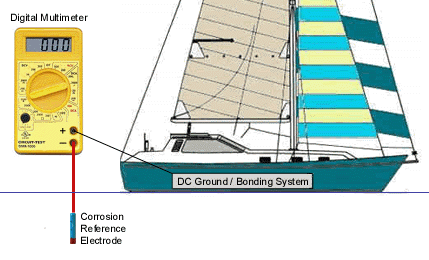
I did a bunch of research on this issue a while back.... below is a copy of my old post. Doug I've never been able to keep shaft zincs on either, and I belive one dinged my prop when slinging off. Welcome to diesel-powered boating. If anyone can tell me why only diesel 33's sling off shaft zincs, I'd love to hear it. My boat's bonding and cathodic protection checks out okay without them, so I just don't use them anymore. You need a high-quality digital multimeter, and very long ~10' leads. Use the resistance setting, which requires that there is a battery in the multimeter. Touch the leads together, and it should read resistance as zero Ohms (use knob or whatever it has to adjust to zero if it not). Then touch the lead to any 2 metal parts on the boat, and you should read zero or near-zero resistance between them. If not, the grounding is no good on between whatever 2 things you touched the leads to. That's the only way to know the bonding system is okay. I had plenty of wires that looked just fine, but when tested they weren't grounded, or worse, were only partially grounded with significant resistance, due to the wire getting crunchy and old inside the original factory crimp connectors, or due to corrosion at the contact lug. As I understand it, it's better for them to be completely ungrounded than to have any sort of partial connection. Start at the zincs, if there is a contact point inside, and check connection to the copper grounding strips on each side of the boat, on the inside faces of the large stringers. Check the connection between the shaft or engine to the copper strips. After establishing that your zincs are connected to your grounding strips, check that each thru-hull, sea strainer, rudders, struts, et cetera are all connected to the copper bonding strips with zero resistance. Basically check anything metal that is in contact with water. In my boat some non seawater-wet things are grounded too, like the rub rails, stainless rails, outriggers and fresh water tank. Not sure why but I don't know everything either. Maybe for lightning or static charges. If you have everything already well grounded then consider yourself lucky, and it would be a simple matter to add a transom zinc if you want extra protection from corrosion. I added one. I used to throw over a zinc fish clipped to a strut bolt before that, before my bonding system work began, and the thing disintegrated noticably over a period of weeks. I also had a stray current near me and a bad galvanic isolator (more on this later). Interesting thing about the ship's bonding system is that if in good shape the zincs last longer, maybe for years. Bad grounding means stray currents that eat up your zincs, then go to work on whetever other metals you have (like your rudders and props). This sounds like a lot of work but it reallys isn't... unless your bonding system needs to be completely re-worked like mine did, in which case YES you have a big job on your hands. To do it right the genny has to come out too, more bad news. Once everything is grounded okay, then you want to take it to the next step: determine if you have enough zincs, or if you have too much zinc (yes it is possible). Then find out if you have stray currents lurking about that come from leaky electrical sources - either your boat, or a neighbor's boat, or from your marina. Only after eliminating all these things can you be sure you are okay. This procedure to test it is below. Note that this can be done at any time, for any piece of metal on your boat... but if your grounding system is not right then you are only checking that one piece of ungrounded metal, not the whole boat. [img]http://www.boatzincs.com/images/sailboat-probe.GIF[/img] You'll need a corrosion electrode, I got mine here: http://www.boatzincs.com/corrosion-refe ... specs.html, a good-quality digital multimeter, and a few spare hours. You should also get and read Nigel Calder's Boatowner's Mechanical & Electrical Manual, it is the absolute bible for this stuff. Turn everything off and disconnect the shore power cord. A vessel’s bonding system should have with a DC voltage between -900 mV and -1100 mV (relative to a silver/silver-chloride electrode) to properly protect underwater metals from galvanic corrosion. Readings less than -900 mV indicate the cathodic protection system is weak and/or failing. Your bonding system is not working, or/and you do not have enough zincs. Readings higher than -1150 mV indicate overprotection, a situation that could damage underwater steel, aluminum alloys and wooden thru-hull backer plates. If you get this condition then you have too many zincs - remove some. After taking an un-hooked reading, start by hooking up the shore power and take another reading. Then start turning on things on the boat one by one, all while watching the readings as you go. Readings that change dramatically as you turn electrical circuits on or off indicate a problem with that particular circuit or component. Do this again with the genny running. Check everything, DC and AC, and actually turn on your radios and chartplotters too. If the voltage reading changes when you hook up the shore power cord then you are getting stray currents from the marina's leaky power grid via. your shore power cord ground wire, through your boat's underwater metals, to the seawater and finally to the ground. This is a very common condition and cause for quick loss of zincs and for corrosion in general. In this case you need a new galvanic isloator, unless the stray current is over 1.5V in which case any isolator will be overpowered and something else is very wrong. If you have over 1.5V don't swim in that water or you could get paralyzed by it and drown, which is suspected to be the hidden and underlying cause of most marina drownings. This is why I won't dive on my boat in marinas anymore. There is more, but this is the grand summary of what you need to do to check out your bonding and cathodic corrosion protection (zincs). On my 20 year old boat I needed all new bonding wires, a new galvanic isloator, and in the slip I was in at the time I still had something going on. I was loosing zincs too fast. It wasn't until I got the corrosion reference electrode was I able to find the problem: my neighbor's sh!tbox sailboat. I turned off his shore power and the current level on my boat changed dramatically (bingo). I moved to another slip and the problem went away. So... if you cruise, the electrode and multimeter should be kept with you. Before and after hooking up to shore power in a strange marina check the voltages, you never know if you just parked next to an electrical nightmare boat. The guys throwing the stray currents will sometimes get no damage to their boats at all, but are floating doom for their neighbors.
"Island Time" 1987 Bertram 33 SF 3208T Cats